Tuesday, June 30, 2009

Living La Vida Sawyer

by guest blogger Nora Lewis Allen

Anyone who lives in the Northeast has undoubtedly realized that it has been raining—a lot. It hasn’t really felt like summer until recently, and I’ve been taking as much time as I possibly can to be outside. Today was absolutely beautiful, so when a friend called me this afternoon and demanded that we MUST go to Steep Rock, a local preserve, to swim in the river and enjoy the last day of June, I couldn’t turn her down. The Shepaug River at Steep Rock

I shut my computer and turned away from my to-do list of publicity tasks, at the top of which ironically was writing this blog, and decided that river traipsing was far more important (sorry Richard!).

When we got to our favorite grassy knoll it was over-run by small campers from the local Indian Institute. We decided to hike to our favorite childhood spot instead—the elusive old railroad trestle and rope swing. There was a chance that we would be trespassing on private property, and because of the recent rain a teenage boy had actually gone missing in the surging river. We decided to take the risk. Stupid? Yes. Worth it? Definitely.

The trek to the rope swing took longer than we remembered. We had to climb over a giant felled pine tree, walk through an old, wet, dark railroad tunnel, and swim across a river where we grossly underestimated the speed and strength of the current. Author climbing over a felled pine tree

The rope swing however, was better than I could have imagined. When we arrived at the river bed across from the swing I felt like I had been transported directly into a Mark Twain novel.
View of the rope swing

I don’t know if it was the place, the day or the idea of it all, but I cannot remember having better afternoon. Because I was older I could appreciate the rarity of it—a perfectly preserved, isolated section of the river where I was able to spend four hours and the entire time thought of nothing other than what I was doing at that moment. It was quintessential nature; at one point a red-tailed hawk even swooped down and perched in a nearby tree. Preparing to climb through yet another felled tree

During the trek I thought a lot about Born to Explore. When walking we came across a bear track, and I thought of the chapter on tracking, and as I was gradually swept downstream when I crossed the river I thought about Richard’s adamant dedication to safety. I think that every human has an innate desire to explore, but it is the “don’ts” that hold us back—I don’t have time, I don’t know how, I don’t have the resources. But as Born to Explore teaches us, backyard exploring is so much easier than you could ever imagine. Anyone can do it, and the result is unbelievably rewarding.
The light at the end of the railroad tunnel

As we left I commented that I felt like we were doing something Tom Sawyer would have done—carousing through the woods and trespassing without a care in the world. And though I am not advocating trespassing, whether you are twelve or twenty or two-hundred there is a little part of Tom Sawyer in all of us, waiting to be discovered by a small and fun adventure.
Author preparing to swing

While I write this, I realize that I have a significant amount of cuts on my legs that are starting to sting and I am 90% sure that I walked through a bed of poison ivy. My only regret? I wish I had worn footwear that was more advantageous to exploring.

Monday, June 29, 2009

Birds Everywhere!


By guest blogger: Cassandra Lobo

I’ve never cared much for birds. Actually, I’ve always been quite terrified of them ever since I was about 6 years old. I’m not really sure what instilled this fear in me, but I do know that birds and I were never the best of friends. One time while I was at the park with my family, I was innocently feeding the ducks that were swimming in the pond. The ducks were somewhat tame and did not seem bothered that we were throwing chunks at bread towards them to eat. I spoke to soon. I threw my last piece of bread and without warning a mad duck came charging towards me. Not knowing what possessed this particular duck, I ran screaming. I was much more concerned with watching the duck chasing me then watching where I was going and all of a sudden …BOOM! I smacked right into a one of the swing set poles and flew backwards. Besides being humiliated in front of all of the other kids that were at the park that particular day, I ended up with a massive bump right in the center of my forehead! See why I don’t like birds?

My hate for birds recently lightened when I came home from college this summer. My mom had hung a beautiful Geranium plant on our deck right in front of our kitchen window. Within a few days, a Mourning Dove had claimed this particular Geranium as its new residence and assembled a nest. The Mourning Dove (whom I later on named House) had laid 2 small, bright white eggs. I found myself constantly catching a glimpse of House and her soon to be hatched babies. I researched Mourning Doves and learned quite a bit on them.


I gave the marvelous nest building credit to House, but in fact it is actually the male bird that creates the nest. I was also fascinated when I learned that both the male & female produce something called “dove milk” to feed their offspring. Adult Mourning Doves feed almost entirely on small seeds scattered on the ground. Also, Doves eat small pieces of stone or gravel, commonly known as "grit", which is stored in the gizzard and used to grind up the seeds they eat (How interesting!). I also learned that the male doves sit in the nest from the late afternoon and through the night, while the female dove sits in the nest throughout the morning and early afternoon.


Most serious birders create a list of all the bird species they've identified with absolute certainty during their whole lifetime of serious birding. This is list is called a “Life List”. I was not familiar with a “Life List” until I fell upon it on the “Born to Explore” facebook fan page. Although I myself have not yet created a “Life List”, my latest curiosity in birds has caused me to research birds more frequently and compile a list of interesting bird facts.


Here are some of the interesting facts I have found:

  • The most yolks ever found in a single chicken's egg is nine.
  • Pigeons can reach speeds up to 100 mph.
  • The Royal Albatross' eggs take 79 days to hatch.
  • A bird's heart beats 400 times per minute while resting and up to 1000 beats per minute while flying.
  • Hummingbirds eat about every ten minutes, slurping down twice their body weight in nectar every day.
  • Penguins, ostriches, and dodo birds are all birds that do not fly.
  • The strike of the eagle talon is so powerful that its force is twice that of a rifle bullet.
  • The only backwards and sideways flyer is the hummingbird
  • A hawk's vision is so good that it can see a mouse from a height of one mile.

Wednesday, June 24, 2009

The Urban Explorer

by Guest Blogger Lucy Mele


A few months ago, I decided to accept a short-term job at a non-profit in New York City. The job itself was so exciting; I would be working with a Nobel Prize-winning author (who happened to be one of my personal heroes), doing work for his humanitarian foundation. I was ecstatic.

But as cool as the actual work would be, the idea of spending almost every day of my summer commuting back and forth from my house in Connecticut to New York City was less than thrilling.

As someone who loves being outside and loves exploring, I never thought I would be able to give four hours of my day to Metro North. That commuting time, combined with the number of hours I’d be spending in the office, meant that I’d be losing, on average, 48 hours of valuable summer daylight each week. That’s almost 200 hours a month without hiking, swimming, or hanging out with my dog at the lake. This was a far cry from working with Richard on “Born to Explore” -- the whole idea behind the book is to get people off their computers and outside!


Author and her dog at a local lake

However, one big misconception that I bought into prior to meeting Richard is that “being outdoors” means that you have to be in an area with woods, lakes, and parks. Truth is, cities like New York have tons of cool outdoor exploration possibilities. If you comb through the pages of the book, you’ll find, just as I did, all the different ways to make outdoor exploration work for you, wherever you are and whatever your situation might be.

For example, thousands of commuters (including myself) pass through Grand Central Terminal every single day. In our hustle to and from the office, it’s easy to miss that its limestone walls are home to tons of different marine fossils from the Jurassic era.

Inside Grand Central Terminal

In addition to fossils, you can find some pretty cool living, breathing organisms and species all over the “urban jungle.” In 2003, Richard and a friend ran a 24-hour Bio-Blitz in Central Park, and not only discovered over 800 existing species, but also found 202 new species of life that had never before been identified.

There are also several different and unusual forms of life in the many different nature preserves within the city, such as the Brooklyn Botanic Garden. Here, in addition to the typical plants native to New York, you can also see several non-native plant species that can unexpectedly grow and flourish in this type of climate, like palm trees.


Richard and friends during the 2003 Bio-Blitz

If animals are more your thing, there’s a cool World Wildlife Fund web site listed in the book where you can search by your town or city to see just how many different species are documented in your area (http://www.worldwildlifefund.org/wildfinder/searchByPlace.cfm). I ran a quick search using my hometown zip code in Fairfield, CT, and discovered that I share my neighborhood with 376 different kinds of animals. I then checked out my office zipcode (right next to Central Park) and was surprised and excited to see that I got the same result.

Wildlife exists all over this planet, even in the most unexpected places. So even if your backyard is primarily concrete, it’s worth heading outside to see what you can find.

Sunday, June 21, 2009

Sick of the same old Druid rituals on the summer soltice?


Find the Earth’s Circumference Using Shadows
If you are sick of the same old tired Druid rituals on the summer solstice and have a healthy dose of skepticism about mundane things like the earths circumference you can duplicate an experiment Eratosthenes, a Greek geographer (about 276 to
194 b.c.) used to determine the earth’s circumference over two thousand years ago.

Eratosthenes:Father of geography or a guy with a lot of time on his hands?

Note: Although this experiment works best on the summer solstice when the sun is in its highest position in the sky for the year but can be tried throughout most of the year.
Estimated Time 20 Minutes


The ultimate measuring stick in NY's central Park

GEAR LIST
• Meter or yard stick, or a rod 3 to 5 feet long
• Carpenter’s t-square to help mea sure a vertical position for your
meter stick
• Tape
• String (at least twice as long as the stick)
• Protractor
• Large piece of paper or cardboard if you cannot adequately mark
the ground
• Globe or world atlas
• A sunny day


Author on the pyramid of the sun in Mexico


How to just do it!
1. Attach the string to the top of a stick approximately 3 to 5 feet
long.
2. Push the stick into a level area of ground or use a stand to achieve
a true vertical position.
3. Use the carpenters t-square to help achieve this vertical position.
4. Find solar noon in your area by consulting your local newspaper or
through going to http://solarnoon.com/ on the Internet.
5. At solar noon, pull the string taut to the end of the shadow of the
stick, and then carefully secure the string to that point on the
ground without tilting the stick.
Mea sure the length of your shadow. I put a ruler right on the
ground and mea sured the shadow directly.
FYI You can calculate solar noon for your location and time zone by
Knowing the exact midpoint between sunrise and sunset times.
Determine the angle between your string and stick by using a protractor.
If math is your thing, you can use the trigonometry formula of
cos x –1 of the length of shadow divided by height of stick.
In my case, in Central Park the angle was 40.5 degrees.
TIP: If you don’t know your latitude and longitude, check http:// ter
raserver -usa .com/
Determine the distance of your location from the equator by consulting
a globe, an atlas, the Web, or use the math formula that I used
for New York’s Central Park.
By my calculations, New York’s Central Park is 2794.3227 miles
from the equator.

Here is the math formula that I used. My mind gets foggy when I
hear the words math formula, but see if you can plug in your locations
to this step- by- step formula.
We know that Central Park’s Latitude is 40 degrees 74 minutes
north
Each degree = 60 minutes of arc
1 minute of arc = 1 nautical mile
40.74 (latitude of Central Park) × 60 (minutes of arc) = 2428.2 nautical
miles from the equator to Central Park.
1 nautical mile = 1.15077945 statue miles
2428.2 nautical miles × 1.15077945 = 2794.3227 statue miles.
• Apply your information to the formula below and you will know
the earth’s circumference!
024-39972_ch01_2P.indd 142 2/5/09 5:48:01 PM
Multiply your distance to the equator by 360 degrees, and then divide
by the mea sured angle at solar noon during the equinox. Your answer
should be that the circumference around the poles is 24,860 miles.
In my case I multiplied 2794.3 (my distance to the equator) by 360,
which yielded 1,005,948.
I divided by my solar noon angle of 40.5 degrees (1,005,948 ÷ 40.5)
which yielded my result of 24,838 miles. Not bad, but obviously not as
good as the Greek geographer Eratosthenes who did this many many
years before me—without a calculator.
For full dtails check out chapter 16 in Born to Explore

FYI The true circumference of the earth at the equator is actually
24,902.4 miles (40,076.5 km), due to the earth’s rotational speed
and Earth’s liquid outer core and solid inner. Did you know that
Earth is the densest known planet in the solar system?

Saturday, June 20, 2009

What can the outdoors do for you?!...

Guest Blogger: Cassandra Lobo

Playing outdoors is almost everyone’s favorite past times. Whether you are searching for beautiful butterflies, digging for gold, or going on a safari adventure the outdoors is always a great experience. Playing outdoors is extremely necessary for healthy physical development.

Not only is it important for physical development, it also plays a role in building self confidence. Self confidence is gained while adventuring out in the outdoors and successfully completing a task. I was recently in the backyard trying to teach my four year old cousin how to swing on his brand new swing set. He would carefully inspect how I would pump my legs before trying it on his own. I coached him on when to pump his legs in and out. He tentatively tried to swing on his own, but continuing to watching me for guidance. After observing my technique for a period of time and trying on his own, he mastered the technique himself.

Confidence is gained through moving from first attempts, then to failures, and then having the tenacity to continue with the task until it is mastered. Confidence gained from tasks performed outdoors is not only seen in children, but also in adults. Playing outdoors allows one to conquer their fears and build confidence.

Outdoors play is also great for many other reasons. Outdoor play allows one to use creativity and develops their imagination, dexterity, and other strengths. Most of all, playing outside encourages individuals to interact with the world around them. Individuals that do not take a chance to experience the outdoors never truly appreciate the beauty of the world around them or never challenge themselves. There are so many wonderful things we can experience just in our own backyards!

June 21 is only two days away and it will officially be Summer ... so get outside!! Take a weekend trip to the Grand Canyon or other National Parks, visit a local park or outdoor attraction, or simply grab a copy of "Born to Explore" by Richard Wiese and be a backyard explorer!

Thursday, June 18, 2009

Do drink the water...and then refill it from the tap!


Some animals are better than others when it comes to storing water


Guest blogger: Lucy Mele

I came across these interesting facts while doing research for this week's blog and thought that they were important enough to share:


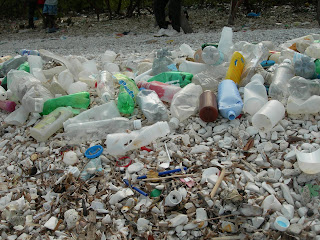
* According to the Container Recycling Institute, 66% of the 215 billion aluminum, glass, and plastic bottles sold in the US in 2006 ended up in landfills? That's almost 142 billion bottles. And because incineration releases toxins, and plastic doesn't biodegrade, all those bottles are staying put for around 1,000 years.

* The Earth Policy Institute says that producing the plastic for all of the bottles we use annually uses enough oil to fill 100,000 cars with gasoline. This doesn't include the oil and gasoline that's used to transport the water we drink (prime example: think about that long, expensive flight your Fiji water has to take to end up at a NYC deli).

* The US EPA actually has stricter regulations on tap water than it does on bottled water. Additionally, The amount of energy it takes to process, bottle, label and transport single-serve water is 2,000 times more than the amount of energy necessary to make tap water(LiveScience.com).


Destined for a landfill or the ocean

I realize the irony in that last week, I wrote about the importance of drinking safe, bottled water and this week, I'm telling you how bad it is, so let me be clear: while I definitely advocate opting for the safest choice when you're traveling, I think it's important to heed these statistics when you're in a place where you know the tap water is safe and drinkable.

Because let's face it; these statistics are pretty startling. But the good thing is, they're not impossible to combat. Take statistic #3, for example, which tells us that the water coming out of our tap is not only safer than the bottled stuff, it's also greener and more cost-efficient. Just think about how much money and energy we would all save if we purchased refillable bottles (one time) and continuously used our tap to fill them.

Reusable bottles like Nalgene and Sigg run between 15-30 bucks and can literally last a lifetime, depending on the brand. My personal preference is Nalgene, not only because they're an environmentally friendly company, but they also make a damn good bottle (just ask Richard, who talks about them in Born to Explore, and has actually used them to save lives!).


In fact, Nalgene just launched the Nalgene Community Sustainability Program, which partners the company with communities to help them reduce their carbon footprint by ditching the single-serve bottles and replacing them with the reusable kind. They've also teamed up with Brita to promote the Filter for Good campaign in an effort to encourage people to go green.


Purifying water on Kilimanjaro

One of the cool things about all of these pro-tap movements and statistics is that it's giving other major companies that aren't necessarily so environmentally aware the much-needed kick in the rear to do something about the waste they create. Just last week, Coca Cola Japan announced plans to introduce lighter-weight, easily crushable bottles for their LOHAS mineral water. This simple change has the potential for big impact; if the bottle becomes widely used, then delivery loads shrink, which enables the company to pack more in each load, run loads less frequently, and reduce their fuel intake, ultimately cutting costs.

Catching a rainbow:one of the many uses of a Nalgene bottle

Cities are also realizing the economic and environmental benefits of weaning themselves off of bottled water. Richmond, VA, has award-winning tap-water, but up until May, the workers at City Hall were drinking from water coolers. By ending the contract with their water provider, they'll now save over $200,000 a year. San Mateo County in California made a similar move this year, and expects to save around a quarter of a million dollars annually.
Even though companies and municipalities are working to do their part, sales of bottled water are continuing to rise. This year, we're expected to exceed 50 billion bottles worldwide. So take a tip from our friends over at Nalgene and go out and buy yourself a reusable bottle. Not only will your wallet thank you, but Mother Nature (& the rest of us) will be eternally grateful.

Author enjoying the water