Showing posts with label Richard Wiese. Show all posts

Saturday, July 25, 2009

Don’t let the sun burn and the bugs bite!


By guest blogger - Cassandra Lobo
The summer season is arguably the most relaxing and enjoyed seasons of them all. The summer season brings with it a handful of outdoor picnics, sun bathing at the beach, and family camping trips. Although summer time is when the living is easy, there are some precautions one should take before stepping outdoors. Anyone who knows me or even simply just read my Ninja Sun Hat blog, know that I am an avid sun worshiper. Extremely bad and dangerous addiction … I know, I know! No need to preach to this choir! Although a golden tan may look appealing, the actuality of what a sun tan is is far from attractive. When skin is exposed to the sun, it protects it’s self from the harmful ultraviolet rays by creating a brown-colored pigment called melanin. This process is extremely dangerous and harmful to your skin.


Sun burn is also commonly taken for a common, unimportant issue. Truth be told, it is extremely serious and should not be taken lightly. Sun burn is simply a burn from the powerful UV rays. The outer layer of skin on your body, called the epidermis, contains dead cells. But just below the dead cells is a layer of living cells. By sitting in the sun, you expose yourself to ultraviolet light. Ultraviolet light has the ability to kill cells. When Ultraviolet light hits the layer of living cells in the epidermis it damages and kills. The body’s reaction to repair the dead cells is to increase the blood flow in the affected area. It opens up capillary walls allowing white blood cells to enter and remove the damaged cells. The increased blood flow makes your skin warm and red, also known as “sunburn”.


Before heading outdoors, don’t forget to apply a sunscreen with an SPF of atleast 20! If sunburn does get the best of you, here are some very useful tips that can help soothe any burn:


-Hydrate, Hydrate,HYDRATE! .. A great, refreshing drink to enjoy while the sunburn is not so pleasant is: equal parts of pineapple and black cherry juice. The pineapple juice contains an ingredient, called bromelain, which is a substance helpful for reducing inflammation. The black cherry juice contains an antioxidant, called anthocyanins, which helps the body relieve inflammation. Drink two or three cups daily to allow the burn to cool


-Apply a thin layer of plain yogurt on to the burn. The yogurt must contain live cultures. This will help cool the
burn.

Summer’s unwelcomed guests can also be another picnic ruiner. During the summer months, bug spray is a necessity and should always be applied when outdoors. Fleas, ticks, and bees are be quite pesky during these months. It is humans versus bugs and, unfortunately, most of the time we are not the winners. Here are some quick anti-itch remedies for when the bug wins the battle:

- Apply honey to a bug bite to bring relief and prevent infections. Honey has long been known for its antibiotic purposes.

- Be as cool as a cucumber. Place cucumber skins on top of the bites to soothe the itching irritation. You can also cut round slices from a fresh eggplant and place on top of the bite to draw out toxins and appease irritation.

- Apply tea tree oil to bites every 2 to 3 hours to relieve itching and aid healing. Tea tree oil possesses antiseptic, antifungal, and antibacterial actions and has been recognized by recent studies as playing a supportive role in skin care.

- For flea bites, soaking in a warm bath of Epsom salts and baking soda can ease itching.


If your summer includes relaxing on the beach, canoeing down the river, or just playing in your local park, make sure to pack some summer necessities. A well–planned survival kit, such as the Altoid Survival Tin mentioned in “Born to Explore, can ensure that you have a fun and healthy outdoor experience!

Friday, July 17, 2009

Young People, Big Adventures

by Guest Blogger Lucy Mele


Author on an adventure at Age 22

Yesterday, 17-year-old Zac Sunderland finished a 13-month solo sailing trip around the world, making him the youngest person in history to independently circumnavigate the globe.
Throughout his trip, the teenager endured more trials than most people do in a lifetime: bad storms, long periods without sleep, and even a brief encounter with pirates in the Indian Ocean (luckily, he was able to put a call into Australian authorities using a satellite phone and had a loaded pistol at the ready in case he was approached).

17-year-old Zac Sunderland on his boat

Zac’s journey is an incredible story, but the coolest thing about it is that it’s not the only one of its kind. Since the beginning of time, amazing things have been accomplished by young people with big goals and the confidence and determination to see them through.

Take Richard, for example, whose lifelong passion for science and exploration all began when he climbed to the top of Mt. Kilimanjaro – at age 11. Since then, he’s discovered hundreds of new forms of life, in areas as diverse as Ethiopia and New York City’s Central Park, and, in 2002, became the youngest-ever president of the Explorer’s Club.


Richard teaching some Boy Scouts all he's learned about science

There’s also Maggie Doyne, who took a gap year after high school to backpack the Himalayas and never left. She was touched by the number of orphans she saw, and decided to take her life savings to build an orphanage and a school. I saw her at this year’s Do Something awards, where she took the top prize – a $100,000 grant to continue the work she began when she was just 17 years old.

I remember growing up, when adults would ask what you wanted to be someday, everyone had these great, big dreams of becoming an astronaut or a professional sports player or President of the United States. Somewhere along the way, for most people, these dreams faded to make room for more practical goals and the lofty ideas of “changing the world” became intangible and unrealistic.

Budding Scientists and Explorers in Central Park

So, when Zac arrived to cheering crowds in California yesterday, he had some great advice for other people his age who might be struggling with whether or not to pursue their goals:
"I think society puts young people in a box…and does not expect them to do much but go to high school and play football and stuff like that. This just shows they can do a lot more with some strong ambition and desire. My [advice] is to get out there and do your thing with all you got."

Thursday, July 16, 2009

Squid Invasion

by guest blogger Cassandra Lobo

Things seemed a little fishy last Saturday in San Diego, California. This previous Saturday, a 4.0 earthquake struck the coast of San Diego. Earthquakes are very common in this area, however what happened afterwards was quite bizarre. Minutes after the earthquake had struck, dozens of dazed Humboldt squid were found lining the La Jolla Shore beach. These particular squids were about 4 feet long and weighed nearly 40 pounds.

Many questions were arising after this peculiar squid incident that occurred. Why were these squids washed up on the shore? Did the earthquake cause the squids to become disoriented? Was the pH level after the quake too high for these water bound creatures? Or was simply just a coincidence? The level 4 earthquake that struck may have played a factor with the squids washing up on shore. The earthquake had hit approximately 20 miles from the La Jolla shore. When an earthquake strikes, there is a shift of continental crust which causes a shock wave. These shock waves are what we feel. The shock waves that were produced in this particular earthquake traveled through the ocean and caused harm to some of our sea life. Many fish and sea life have sensors that are able to feel pressure and direction. These sensors are very similar to those contained in the human ear. The Humboldt squid may have experienced damage to their sensors during the earthquake. Humboldt squid generally stay in waters that are 660–2,300 ft, but with the damage caused to their sensors, the squid became extremely disorientated and were unable to navigate correctly, causing them to wash up on shore.
Another possibility for these sea creatures squirming around the La Jolla shore may have been due to the pH level. The gases released from the earthquake could have caused the pH level to increase. Humboldt Squid are very sensitive to pH. They need more oxygen during daylight than any other animal in the sea, according to scientists at University of Rhode Island. Squid now appear to be joining the list of marine creatures that are at risk from rising levels of carbon dioxide in the atmosphere. As the oceans absorb some of this CO2 load, pH levels drop, and the water becomes more acidic. A test done by Brad Seibel, of the University of Rhode Island, was done to see if pH really did play a factor to squid. He netted 86 jumbo squid in the Gulf of California and placed each squid in different a water-filled container, that varied in temperature, oxygen and CO2 levels. The results showed that when facing high CO2 levels, the creatures became 45% less active.
Another theory is the change in water temperature. The San Diego area has experienced a lot of cold water coming up to the shore. Cold water has been known to bring a lot of nutrients and life, causing the squid to follow the food supply.

In the end there are only theories as to what exactly happened, and exactly how the earthquake affected the squid. What is quite obvious, however, is that we still have quite a bit to learn, and in the end we are equivalent to a nine year old wondering why the tides go in and out. Really, it's quite humbling to realize that we can't even comprehend thoroughly the hardships that a squid endures.

Too cool to burn? Wrong.

by guest blogger: Cassandra Lobo


Summer is finally here! … Well at least on some days it is! The weather here in Connecticut has been extremely random the last few months. It is constantly jumping from 85 degrees one day and, without warning, 65 degrees the next. Saturday’s weather was warm enough for the beach (or so we thought!) therefore my mom, aunt, four year old cousin, and I headed down the street to the beach. The constant wind at the beach made it a bit chilly and not desirable beach weather. After debating if we should go back home where it was much warmer or stay at the not so pleasant beach, the stubbornness of three women struck and leaving the beach was not an option. Occupying my time and trying to take my mind off my goose bumps, I adventured to the shore of the water to build sand castles with my cousin.


The majority of the shore was lined with breeding horseshoe crabs. The pesky kids next to us were throwing rocks at the ancient creatures (did you know horse shoe crabs predate the dinosaurs!?) which really troubled me. These harmless creatures were helpless for they could not defend themselves against the problematic children. Not long after, the lifeguard on duty came to the horseshoe crab’s rescue and put an end to the children’s uncaring behavior. I sat and chatted with the lifeguard and learned that horseshoe crabs are endangered species and the beach is doing all they can to prevent any harm to the creatures.


I learned some other very interesting facts about horseshoe crabs. A horseshoe crab actually can see UV light with its ten eyes. The horseshoe crabs you see resting on the shore of the beach are all adults. Younger horseshoe crabs live on the intertidal flats and spend most of their day buried underneath the sand. The horse crab education session and sand building fiasco turned into a two hour ordeal and by that time it was time to head back home. While walking home, I noticed that my face and shoulders felt a tad taut, but I did not think much of it.


I arrived home only to look in the mirror to see my upper body a dazzling shade of fire engine red…except it was definitely not dazzling. In fact, it was quite unpleasant, painful, and extremely sore. I spent the next couple of hours applying foul smelling aloe hoping the shade of red would tone down. Unfortunately I still resembled a lobster and wished I would have applied sun block. Who thinks of sunscreen when the temperature barely broke 70 degrees? I guess I under estimated the power of the sun!

The ninja sun hat mentioned in “Born to Explore” would have been the perfect solution to this awful sunburn. The ninja sun hat is extremely easy to create but makes all the difference when out in the sun. It is created by strategically placing a basic t-shirt on your head to protect your face and neck from the blistering sun. The way the t-shirt is placed on your head resembles a ninja hat which is not only a great way to protect yourself from the sun but also a great costume idea. Oh what an adventurous day at the beach! After experiencing this horrible sunburn, I will never again forget my sunscreen or ninja sunhat!


Monday, July 6, 2009

The day I almost died


Member of the Belize rescue team


There I was, caught underneath a tree in a white-water river in Belize, thinking,
“This is a really stupid way to die.” However, because of the training my father, a 747 captain, had instilled in me growing up I instinctively surrounded myself with a “bubble of calm.” I had learned over the years that whenever emergencies or tough situations arise to slow things down in my head and try to assess the situation. Nevertheless, I knew I had about a minute-and-a-half of available oxygen before I’d black out and drown.

A crowded field heads into dangerous rapids


Luckily for me, that never happened. I was able to shift the boat that was on top of me, free myself from the maze of tree limbs that were holding me captive, and swim toward the light. When I surfaced the first image that greeted me was my friend and teammate Bo Parfet hanging onto a branch against the surging river. He had come up about a minute earlier.


Perhaps too much testosterone and not enough brains


It was day two of the La Ruta Maya, a grueling, multi-day canoe race, and we were now last among a field of just under a hundred vessels. Though we didn’t win, this was only the first of many adventures that Bo and I would share together. Often, the kind of life-threatening incident that we’d just experienced deeply affects a person’s sense of fearlessness, and I wondered how it was going to affect Bo. You see, in my mind he was still untested. I did not know then that, during the next few years, he would witness a death on Mount Everest and have several brushes with it himself in some of the world’s most exotic locations.
As for me, I have thought about that day often and consider myself lucky. The scenario could have been drastically different, and I don’t know if I would have survived. I have always prided myself on being risk adverse and safe in the field, but good explorers or adventurers are able to sense dangerous situations, unlike I had done on that day on the river in Belize.

A widely used phrase, though somewhat cliché, is that the mark of real character in a climber is not how he stands on the summit while holding a flag, but how he pulls himself out of an icy crevasse. Expeditions have a way of revealing a person's true personality, mostly because teammates spend so much time together in close quarters and often in trying conditions, that all pretenses quickly vanish. No one should ever underestimate the value of being a good teammate. A group that works cohesively together will triumph over individual effort every time.


Author with Bo Parfet at Everest base camp


The easy road is safe and predictable, however sticking your neck out on an expedition or trying to extend yourself in any field of endeavor is difficult, especially when you run the risk of looking foolish if you fail. Still, you might as well face the fact that if you’re going to be a leader, you will undoubtedly fail at some point. The important thing is to learn from experience, and also to understand that on those occasions when you put every ounce of energy and passion into achieving something, the exhilaration of realizing your ambition will be well worth the fight. If I had died under a tree in a river in Belize I would have been pretty embarrassed, but I was able to stay calm and as a result learned an invaluable lesson. It is important to remind yourself that though every person lives, it takes a person with true courage to experience failure and continue to live outside their comfort zone.

Wednesday, June 24, 2009

The Urban Explorer

by Guest Blogger Lucy Mele


A few months ago, I decided to accept a short-term job at a non-profit in New York City. The job itself was so exciting; I would be working with a Nobel Prize-winning author (who happened to be one of my personal heroes), doing work for his humanitarian foundation. I was ecstatic.

But as cool as the actual work would be, the idea of spending almost every day of my summer commuting back and forth from my house in Connecticut to New York City was less than thrilling.

As someone who loves being outside and loves exploring, I never thought I would be able to give four hours of my day to Metro North. That commuting time, combined with the number of hours I’d be spending in the office, meant that I’d be losing, on average, 48 hours of valuable summer daylight each week. That’s almost 200 hours a month without hiking, swimming, or hanging out with my dog at the lake. This was a far cry from working with Richard on “Born to Explore” -- the whole idea behind the book is to get people off their computers and outside!


Author and her dog at a local lake

However, one big misconception that I bought into prior to meeting Richard is that “being outdoors” means that you have to be in an area with woods, lakes, and parks. Truth is, cities like New York have tons of cool outdoor exploration possibilities. If you comb through the pages of the book, you’ll find, just as I did, all the different ways to make outdoor exploration work for you, wherever you are and whatever your situation might be.

For example, thousands of commuters (including myself) pass through Grand Central Terminal every single day. In our hustle to and from the office, it’s easy to miss that its limestone walls are home to tons of different marine fossils from the Jurassic era.

Inside Grand Central Terminal

In addition to fossils, you can find some pretty cool living, breathing organisms and species all over the “urban jungle.” In 2003, Richard and a friend ran a 24-hour Bio-Blitz in Central Park, and not only discovered over 800 existing species, but also found 202 new species of life that had never before been identified.

There are also several different and unusual forms of life in the many different nature preserves within the city, such as the Brooklyn Botanic Garden. Here, in addition to the typical plants native to New York, you can also see several non-native plant species that can unexpectedly grow and flourish in this type of climate, like palm trees.


Richard and friends during the 2003 Bio-Blitz

If animals are more your thing, there’s a cool World Wildlife Fund web site listed in the book where you can search by your town or city to see just how many different species are documented in your area (http://www.worldwildlifefund.org/wildfinder/searchByPlace.cfm). I ran a quick search using my hometown zip code in Fairfield, CT, and discovered that I share my neighborhood with 376 different kinds of animals. I then checked out my office zipcode (right next to Central Park) and was surprised and excited to see that I got the same result.

Wildlife exists all over this planet, even in the most unexpected places. So even if your backyard is primarily concrete, it’s worth heading outside to see what you can find.

Sunday, June 21, 2009

Sick of the same old Druid rituals on the summer soltice?


Find the Earth’s Circumference Using Shadows
If you are sick of the same old tired Druid rituals on the summer solstice and have a healthy dose of skepticism about mundane things like the earths circumference you can duplicate an experiment Eratosthenes, a Greek geographer (about 276 to
194 b.c.) used to determine the earth’s circumference over two thousand years ago.

Eratosthenes:Father of geography or a guy with a lot of time on his hands?

Note: Although this experiment works best on the summer solstice when the sun is in its highest position in the sky for the year but can be tried throughout most of the year.
Estimated Time 20 Minutes


The ultimate measuring stick in NY's central Park

GEAR LIST
• Meter or yard stick, or a rod 3 to 5 feet long
• Carpenter’s t-square to help mea sure a vertical position for your
meter stick
• Tape
• String (at least twice as long as the stick)
• Protractor
• Large piece of paper or cardboard if you cannot adequately mark
the ground
• Globe or world atlas
• A sunny day


Author on the pyramid of the sun in Mexico


How to just do it!
1. Attach the string to the top of a stick approximately 3 to 5 feet
long.
2. Push the stick into a level area of ground or use a stand to achieve
a true vertical position.
3. Use the carpenters t-square to help achieve this vertical position.
4. Find solar noon in your area by consulting your local newspaper or
through going to http://solarnoon.com/ on the Internet.
5. At solar noon, pull the string taut to the end of the shadow of the
stick, and then carefully secure the string to that point on the
ground without tilting the stick.
Mea sure the length of your shadow. I put a ruler right on the
ground and mea sured the shadow directly.
FYI You can calculate solar noon for your location and time zone by
Knowing the exact midpoint between sunrise and sunset times.
Determine the angle between your string and stick by using a protractor.
If math is your thing, you can use the trigonometry formula of
cos x –1 of the length of shadow divided by height of stick.
In my case, in Central Park the angle was 40.5 degrees.
TIP: If you don’t know your latitude and longitude, check http:// ter
raserver -usa .com/
Determine the distance of your location from the equator by consulting
a globe, an atlas, the Web, or use the math formula that I used
for New York’s Central Park.
By my calculations, New York’s Central Park is 2794.3227 miles
from the equator.

Here is the math formula that I used. My mind gets foggy when I
hear the words math formula, but see if you can plug in your locations
to this step- by- step formula.
We know that Central Park’s Latitude is 40 degrees 74 minutes
north
Each degree = 60 minutes of arc
1 minute of arc = 1 nautical mile
40.74 (latitude of Central Park) × 60 (minutes of arc) = 2428.2 nautical
miles from the equator to Central Park.
1 nautical mile = 1.15077945 statue miles
2428.2 nautical miles × 1.15077945 = 2794.3227 statue miles.
• Apply your information to the formula below and you will know
the earth’s circumference!
024-39972_ch01_2P.indd 142 2/5/09 5:48:01 PM
Multiply your distance to the equator by 360 degrees, and then divide
by the mea sured angle at solar noon during the equinox. Your answer
should be that the circumference around the poles is 24,860 miles.
In my case I multiplied 2794.3 (my distance to the equator) by 360,
which yielded 1,005,948.
I divided by my solar noon angle of 40.5 degrees (1,005,948 ÷ 40.5)
which yielded my result of 24,838 miles. Not bad, but obviously not as
good as the Greek geographer Eratosthenes who did this many many
years before me—without a calculator.
For full dtails check out chapter 16 in Born to Explore

FYI The true circumference of the earth at the equator is actually
24,902.4 miles (40,076.5 km), due to the earth’s rotational speed
and Earth’s liquid outer core and solid inner. Did you know that
Earth is the densest known planet in the solar system?

Thursday, June 18, 2009

Do drink the water...and then refill it from the tap!


Some animals are better than others when it comes to storing water


Guest blogger: Lucy Mele

I came across these interesting facts while doing research for this week's blog and thought that they were important enough to share:


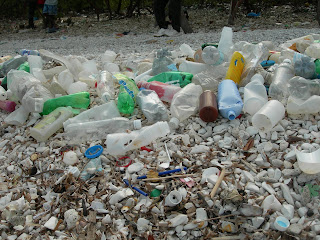
* According to the Container Recycling Institute, 66% of the 215 billion aluminum, glass, and plastic bottles sold in the US in 2006 ended up in landfills? That's almost 142 billion bottles. And because incineration releases toxins, and plastic doesn't biodegrade, all those bottles are staying put for around 1,000 years.

* The Earth Policy Institute says that producing the plastic for all of the bottles we use annually uses enough oil to fill 100,000 cars with gasoline. This doesn't include the oil and gasoline that's used to transport the water we drink (prime example: think about that long, expensive flight your Fiji water has to take to end up at a NYC deli).

* The US EPA actually has stricter regulations on tap water than it does on bottled water. Additionally, The amount of energy it takes to process, bottle, label and transport single-serve water is 2,000 times more than the amount of energy necessary to make tap water(LiveScience.com).


Destined for a landfill or the ocean

I realize the irony in that last week, I wrote about the importance of drinking safe, bottled water and this week, I'm telling you how bad it is, so let me be clear: while I definitely advocate opting for the safest choice when you're traveling, I think it's important to heed these statistics when you're in a place where you know the tap water is safe and drinkable.

Because let's face it; these statistics are pretty startling. But the good thing is, they're not impossible to combat. Take statistic #3, for example, which tells us that the water coming out of our tap is not only safer than the bottled stuff, it's also greener and more cost-efficient. Just think about how much money and energy we would all save if we purchased refillable bottles (one time) and continuously used our tap to fill them.

Reusable bottles like Nalgene and Sigg run between 15-30 bucks and can literally last a lifetime, depending on the brand. My personal preference is Nalgene, not only because they're an environmentally friendly company, but they also make a damn good bottle (just ask Richard, who talks about them in Born to Explore, and has actually used them to save lives!).


In fact, Nalgene just launched the Nalgene Community Sustainability Program, which partners the company with communities to help them reduce their carbon footprint by ditching the single-serve bottles and replacing them with the reusable kind. They've also teamed up with Brita to promote the Filter for Good campaign in an effort to encourage people to go green.


Purifying water on Kilimanjaro

One of the cool things about all of these pro-tap movements and statistics is that it's giving other major companies that aren't necessarily so environmentally aware the much-needed kick in the rear to do something about the waste they create. Just last week, Coca Cola Japan announced plans to introduce lighter-weight, easily crushable bottles for their LOHAS mineral water. This simple change has the potential for big impact; if the bottle becomes widely used, then delivery loads shrink, which enables the company to pack more in each load, run loads less frequently, and reduce their fuel intake, ultimately cutting costs.

Catching a rainbow:one of the many uses of a Nalgene bottle

Cities are also realizing the economic and environmental benefits of weaning themselves off of bottled water. Richmond, VA, has award-winning tap-water, but up until May, the workers at City Hall were drinking from water coolers. By ending the contract with their water provider, they'll now save over $200,000 a year. San Mateo County in California made a similar move this year, and expects to save around a quarter of a million dollars annually.
Even though companies and municipalities are working to do their part, sales of bottled water are continuing to rise. This year, we're expected to exceed 50 billion bottles worldwide. So take a tip from our friends over at Nalgene and go out and buy yourself a reusable bottle. Not only will your wallet thank you, but Mother Nature (& the rest of us) will be eternally grateful.

Author enjoying the water

Thursday, June 11, 2009

What would McGuyver use Mylar for ?


Mylar is more than a fashion statement


Recently while packing for an expedition I was going through my Adventure Medical Kit and started thinking about multiple uses for some of the items in the kit .


I have always thought the mark of a good explorer is being able to take an item or peice of equipment and use it for a host of varying situations. I guess the example most people think about is duct tape. It is the material that is the holy grail of wilderness versatility however I started looking at my shiny space blanket (Mylar sheet) and I thought what would what might MacGyver use Mylar for?


McGuyver the patron saint of ingenuity

First of all Mylar sounds like an ominous, extraterrestrial substance, but it is actually present at most birthday parties you go to. Mylar is the trademark name by Dupont, and it is basically the silver stuff that party balloons are made of or computer parts are stored in or even food is stored. Most people will recognize Mylar as the thin, silver blanket that they hand out at the end of marathons or the “space blankets” that you find in your Adventure medical kit.

Marathoners with Mylar blankets:Boston Globe

Mylar has been around a lot longer than most people think, and even Wikipedia falsely says that it was invented by the space industry in 1964. On the contrary, it was actually developed by Dupont Mylar in 1952 when it grew out of the development of Dacron, and was first used by NASA for their Echo Satellites in 1960.

So what might MacGyver use Mylar for?
First, he would use it for an emergency blanket; he would know that it works the same way a thermos does to keep heat and reduce heat losses in a person's body due to thermal radiation and convection.
Better sad than dead.

In the same manner that it keeps a person warm, sheets of Mylar covering a tent’s inner walls with the shiny surface facing inward, keeps a tent warm. It reflects body heat back into the tent, warming the interior more efficiently.

Mylar can keep a tent warmer even on the North Pole

On the other hand, in an extreme heat situation, covering the outer walls with the shiny surface facing outward will reflect the sun's heat away from the tent, cooling the interior more efficiently. Using a sheet of Mylar will protect the body from heat as it will reflect the suns heat.
However, it might not be a good idea to wrap ones self tightly in Mylar in hot weather because body heat would get trapped by the airtight foil, and you would be the equivalent of a baked potato in an oven. Seems counterproductive no?
MacGyver would also use Mylar to fashion a tent or tarp for protection when the elements got the better of him.
In addition, he would also probably make a hot air balloon or create a kite to aid in rescuers with visual ques.
Since Mylar can be made into balloons it can also be used to make water or food storage bags. Mylar is incredibly heat resistant but you probably cook food or boil water in it for water purification.


Solar oven: Project Surya

With good sunlight Mylar can be woven in to parabolic baskets and made into solar cookers that can be used to cook food or pasteurize water during emergencies when other fuels and power sources may not be available.


Although it is used for solar sails in outer space, in a pinch it could also be used to make a makeshift sail for a canoe or a small boat. A word of caution: Though Mylar is a very strong material, it rips quite easily, and should be avoided when trying to catch gale force winds.

Mylar can be easily made into glacier glasses because you can see through the material in very bright light. Naturally, MacGyver would probably be traveling to a destination with a solar eclipse and would also use it as an inexpensive solar eclipse viewer. Care must be taken however because invisible fissures can form in the metal film, reducing its effectiveness.
Obviously, in an emergency situation, it is a big help if you are found right away. Not only can a sheet of Mylar be used to signal rescuers, but in true MacGyver fashion, he would know that radar waves can be reflected by certain substances such as aluminized Mylar, a lot like the way that light is reflected by a mirror. You want the surface to be hard so it doesn't distort and affect the reflectivity for the radar waves. Think about looking at yourself in a nice, clean, smooth mirror. You get a good representation of what you look like because the light waves aren't redirected by surface irregularities.


The ultimate party baloon

Though metalized party balloons aren't great radar reflectors, they'd be much better than nothing in an emergency. But then again, McGuyver might just keep them as welcome balloons—if he couldn’t be in control of the situation, at least he could enjoy the spectacle!