Showing posts with label Lucy Mele. Show all posts

Friday, July 17, 2009

Young People, Big Adventures

by Guest Blogger Lucy Mele


Author on an adventure at Age 22

Yesterday, 17-year-old Zac Sunderland finished a 13-month solo sailing trip around the world, making him the youngest person in history to independently circumnavigate the globe.
Throughout his trip, the teenager endured more trials than most people do in a lifetime: bad storms, long periods without sleep, and even a brief encounter with pirates in the Indian Ocean (luckily, he was able to put a call into Australian authorities using a satellite phone and had a loaded pistol at the ready in case he was approached).

17-year-old Zac Sunderland on his boat

Zac’s journey is an incredible story, but the coolest thing about it is that it’s not the only one of its kind. Since the beginning of time, amazing things have been accomplished by young people with big goals and the confidence and determination to see them through.

Take Richard, for example, whose lifelong passion for science and exploration all began when he climbed to the top of Mt. Kilimanjaro – at age 11. Since then, he’s discovered hundreds of new forms of life, in areas as diverse as Ethiopia and New York City’s Central Park, and, in 2002, became the youngest-ever president of the Explorer’s Club.


Richard teaching some Boy Scouts all he's learned about science

There’s also Maggie Doyne, who took a gap year after high school to backpack the Himalayas and never left. She was touched by the number of orphans she saw, and decided to take her life savings to build an orphanage and a school. I saw her at this year’s Do Something awards, where she took the top prize – a $100,000 grant to continue the work she began when she was just 17 years old.

I remember growing up, when adults would ask what you wanted to be someday, everyone had these great, big dreams of becoming an astronaut or a professional sports player or President of the United States. Somewhere along the way, for most people, these dreams faded to make room for more practical goals and the lofty ideas of “changing the world” became intangible and unrealistic.

Budding Scientists and Explorers in Central Park

So, when Zac arrived to cheering crowds in California yesterday, he had some great advice for other people his age who might be struggling with whether or not to pursue their goals:
"I think society puts young people in a box…and does not expect them to do much but go to high school and play football and stuff like that. This just shows they can do a lot more with some strong ambition and desire. My [advice] is to get out there and do your thing with all you got."

Wednesday, June 24, 2009

The Urban Explorer

by Guest Blogger Lucy Mele


A few months ago, I decided to accept a short-term job at a non-profit in New York City. The job itself was so exciting; I would be working with a Nobel Prize-winning author (who happened to be one of my personal heroes), doing work for his humanitarian foundation. I was ecstatic.

But as cool as the actual work would be, the idea of spending almost every day of my summer commuting back and forth from my house in Connecticut to New York City was less than thrilling.

As someone who loves being outside and loves exploring, I never thought I would be able to give four hours of my day to Metro North. That commuting time, combined with the number of hours I’d be spending in the office, meant that I’d be losing, on average, 48 hours of valuable summer daylight each week. That’s almost 200 hours a month without hiking, swimming, or hanging out with my dog at the lake. This was a far cry from working with Richard on “Born to Explore” -- the whole idea behind the book is to get people off their computers and outside!


Author and her dog at a local lake

However, one big misconception that I bought into prior to meeting Richard is that “being outdoors” means that you have to be in an area with woods, lakes, and parks. Truth is, cities like New York have tons of cool outdoor exploration possibilities. If you comb through the pages of the book, you’ll find, just as I did, all the different ways to make outdoor exploration work for you, wherever you are and whatever your situation might be.

For example, thousands of commuters (including myself) pass through Grand Central Terminal every single day. In our hustle to and from the office, it’s easy to miss that its limestone walls are home to tons of different marine fossils from the Jurassic era.

Inside Grand Central Terminal

In addition to fossils, you can find some pretty cool living, breathing organisms and species all over the “urban jungle.” In 2003, Richard and a friend ran a 24-hour Bio-Blitz in Central Park, and not only discovered over 800 existing species, but also found 202 new species of life that had never before been identified.

There are also several different and unusual forms of life in the many different nature preserves within the city, such as the Brooklyn Botanic Garden. Here, in addition to the typical plants native to New York, you can also see several non-native plant species that can unexpectedly grow and flourish in this type of climate, like palm trees.


Richard and friends during the 2003 Bio-Blitz

If animals are more your thing, there’s a cool World Wildlife Fund web site listed in the book where you can search by your town or city to see just how many different species are documented in your area (http://www.worldwildlifefund.org/wildfinder/searchByPlace.cfm). I ran a quick search using my hometown zip code in Fairfield, CT, and discovered that I share my neighborhood with 376 different kinds of animals. I then checked out my office zipcode (right next to Central Park) and was surprised and excited to see that I got the same result.

Wildlife exists all over this planet, even in the most unexpected places. So even if your backyard is primarily concrete, it’s worth heading outside to see what you can find.

Thursday, June 18, 2009

Do drink the water...and then refill it from the tap!


Some animals are better than others when it comes to storing water


Guest blogger: Lucy Mele

I came across these interesting facts while doing research for this week's blog and thought that they were important enough to share:


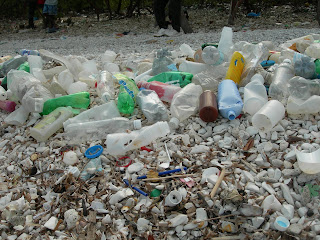
* According to the Container Recycling Institute, 66% of the 215 billion aluminum, glass, and plastic bottles sold in the US in 2006 ended up in landfills? That's almost 142 billion bottles. And because incineration releases toxins, and plastic doesn't biodegrade, all those bottles are staying put for around 1,000 years.

* The Earth Policy Institute says that producing the plastic for all of the bottles we use annually uses enough oil to fill 100,000 cars with gasoline. This doesn't include the oil and gasoline that's used to transport the water we drink (prime example: think about that long, expensive flight your Fiji water has to take to end up at a NYC deli).

* The US EPA actually has stricter regulations on tap water than it does on bottled water. Additionally, The amount of energy it takes to process, bottle, label and transport single-serve water is 2,000 times more than the amount of energy necessary to make tap water(LiveScience.com).


Destined for a landfill or the ocean

I realize the irony in that last week, I wrote about the importance of drinking safe, bottled water and this week, I'm telling you how bad it is, so let me be clear: while I definitely advocate opting for the safest choice when you're traveling, I think it's important to heed these statistics when you're in a place where you know the tap water is safe and drinkable.

Because let's face it; these statistics are pretty startling. But the good thing is, they're not impossible to combat. Take statistic #3, for example, which tells us that the water coming out of our tap is not only safer than the bottled stuff, it's also greener and more cost-efficient. Just think about how much money and energy we would all save if we purchased refillable bottles (one time) and continuously used our tap to fill them.

Reusable bottles like Nalgene and Sigg run between 15-30 bucks and can literally last a lifetime, depending on the brand. My personal preference is Nalgene, not only because they're an environmentally friendly company, but they also make a damn good bottle (just ask Richard, who talks about them in Born to Explore, and has actually used them to save lives!).


In fact, Nalgene just launched the Nalgene Community Sustainability Program, which partners the company with communities to help them reduce their carbon footprint by ditching the single-serve bottles and replacing them with the reusable kind. They've also teamed up with Brita to promote the Filter for Good campaign in an effort to encourage people to go green.


Purifying water on Kilimanjaro

One of the cool things about all of these pro-tap movements and statistics is that it's giving other major companies that aren't necessarily so environmentally aware the much-needed kick in the rear to do something about the waste they create. Just last week, Coca Cola Japan announced plans to introduce lighter-weight, easily crushable bottles for their LOHAS mineral water. This simple change has the potential for big impact; if the bottle becomes widely used, then delivery loads shrink, which enables the company to pack more in each load, run loads less frequently, and reduce their fuel intake, ultimately cutting costs.

Catching a rainbow:one of the many uses of a Nalgene bottle

Cities are also realizing the economic and environmental benefits of weaning themselves off of bottled water. Richmond, VA, has award-winning tap-water, but up until May, the workers at City Hall were drinking from water coolers. By ending the contract with their water provider, they'll now save over $200,000 a year. San Mateo County in California made a similar move this year, and expects to save around a quarter of a million dollars annually.
Even though companies and municipalities are working to do their part, sales of bottled water are continuing to rise. This year, we're expected to exceed 50 billion bottles worldwide. So take a tip from our friends over at Nalgene and go out and buy yourself a reusable bottle. Not only will your wallet thank you, but Mother Nature (& the rest of us) will be eternally grateful.

Author enjoying the water

Saturday, May 30, 2009

Don't drink the water


Guest Blogger:Lucy Mele

When I’m home, I’m not much of a risk taker. I don’t do roller coasters or ski black diamonds. I always wear my seatbelt and I stop at yellow lights. I don’t even put those little red pepper flakes on my pizza (spicy food kind of hurts my mouth a little).

But for some reason, I always gain a renewed sense of invincibility after I leave the boundaries of our half acre plot in the ’burbs to set out on a new adventure. My “travel alter-ego” will often find herself hitchhiking across countries and eating weird things like duck feet and shark blubber. It’s as though I feel compelled – almost obligated – to make new and different decisions when I’m in a new and different place.

There is one risk, however, I’ve always been careful not to take, especially when I’m in a developing country (and by careful, I mean borderline paranoid) and that’s water consumption. No raw veggies, no unpeeled fruit, nothing made or paired with ice. I had the whole routine down to a science. Or so I thought.

I spent a few days in Haiti earlier this month delivering solar-powered flashlights to school kids on the rural island of La Gonave. The island has no electricity, and the students can’t study at night (unless they use a kerosene lamp, which eats up costly fuel and can fill the small, cinderblock huts with greasy black smoke). The trip was through an organization called Haiti Lumiere de Demain (Haiti Light of Tomorrow), which works to create educational opportunities for students in Haiti’s rural areas, as well as build an environmentally sustainable community on La Gonave, where there is currently no waste removal system.
Sci Fi looking giardia

It was a pretty incredible trip – we spent our time talking to people, playing soccer with kids, and getting to know each other over long, plantain-heavy meals at the fabulously decorated home of the equally fabulous Madame Fifi. I got home about a week and a half ago with interesting stories, new friends, and great pictures.

Unfortunately, I also brought home a case of giardia.


Even local tap water can be dangerous


Giardia can be a traveler’s worst nightmare. It’s a microscopic, hard-shelled parasite that lives in the intestine of the person who is infected. Symptoms show up about a week or two after infection, and can be pretty miserable -- cramping, diarrhea, nausea, dehydration, the whole bit.

Aboriginal guts have built a tolerance for local water

Which leads me to where I am now: writing this blog from my couch while sipping Gatorade, watching Saved by the Bell reruns, and wondering how the hell I, queen of Purell, could have possibly picked up the parasite.

I cracked open my copy of “Born to Explore” for answers. According to Richard, giardia can be caused by a number of things, including consuming, swimming in, or accidentally ingesting contaminated water from tainted lakes or ponds, eating infected food, or touching your mouth with contaminated hands.

I still have no idea how I got sick, and, in retrospect, I could have contracted this thing any one of those ways. No matter how crazy I was about keeping clean and avoiding bacteria, there are certain things you have to do, like bathe and eat, to avoid getting sick in other ways.

Author

I guess the lesson here is that parasites can be sneaky, and you can never be too careful about what you consume. Take the advice in “Born to Explore” – “boil it, cook it, peel it, or forget it.”
Trust me, you don’t want to learn the hard way.